
Melchizedek Anointing, Hebrews and the Man of God
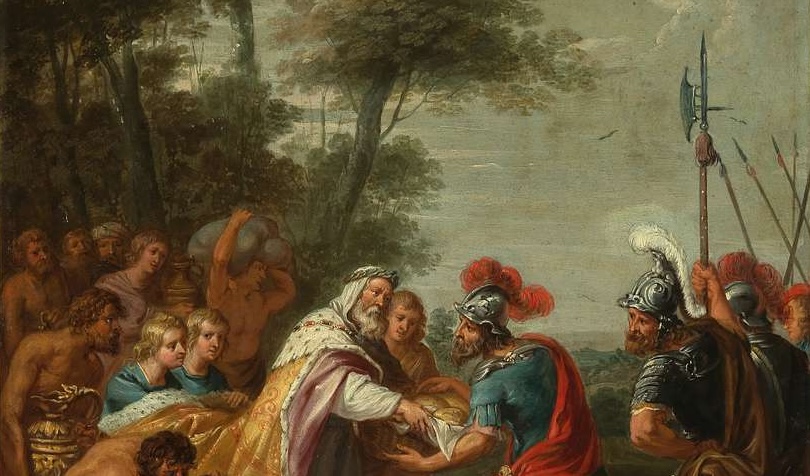
I was recently tasked with listening to a sermon from one of our continent’s many self-proclaimed prophets. Time would fail me to tell of all the abject Bible-handling and aberrant theology. But as I’m preparing a lecture series on Hebrews I was particularly intrigued—read: horrified—by his notion of the “Melchizedek anointing.” Completely ignoring everything else Hebrews says, our prophet banged on about this so-called anointing, highlighting “that the inferior is blessed by the superior” (Hebrews 7:7). Of course, our prophet zealously reminded his flock that, as their superior, he blesses them; that be remaining beneath his covering they will enjoy God’s blessing. So Hebrews was enlisted in floating the prophet’s greatness and assuring the audience of their own spiritual—read: financial—maturity. Only Hebrews isn’t about either of those things.
Below I’ll very briefly consider what Hebrews actually says about Melchizedek, which has nothing to do with an anointing and instead wants us to recognise Jesus’ superiority. In that first section I suggest that our prophet struggles to read Hebrews 5-7 correctly because making too much of Jesus would threaten his own fame. In the second and slightly longer section we’ll look over Hebrews 1-2, which also happens to be about Jesus. There I give some attention to the prophet’s and Hebrew’s competing visions for greatness, seeing as though the Melchizedek anointing apparently makes us kings and queens rather than servants.
How Hebrews Employs the Figure of Melchizedek
After introducing his comparison between Jesus and Melchizedek, the author of Hebrews admits that “it is hard to explain” (Hebrews 5:11). The reason was that the original hearers had “become dull of hearing.” Now, I’m not going to suggest that this description is true of our prophet; nor that while he ought to be a teacher he needs someone to teach him “the basic principles of the oracles of God” (Hebrews 5:12). But he would certainly benefit from some familiarity with the basic principles of exegesis or skill in the word of God (Hebrews 5:13). For even one of my first year theological students would probably be able to tell you that Hebrews’ sustained comparison between Jesus and Melchizedek is about, well, Jesus.
Nowhere in Hebrews 5-7 is anything that the author says about Melchizedek or Jesus extended to believers. For those three chapters simply aren’t about us. Naturally, reaching such a conclusion is difficult for our prophet—and so many others like him—since in his exegetical eyes the Bible is all about himself. Such an inherently self-centred reading of the Bible leaves little room for Jesus, which is painfully evident in his preaching. So perhaps it isn’t that surprising our prophet insists that Hebrews 5-7 is about his own superiority and anointed ability to bless spiritually inferior sycophants. But for anyone with a genuine interest in listening to what God says, it’s fairly plain that those chapters are all about Jesus.
Before moving on, we might highlight one more reason our prophet struggles with these chapters. When they do address Christians, the author majors in loving service of others (Hebrews 6:10), and patient endurance (Hebrews 6:11-12). Such exhortations hardly square with the man of God’s empty promises of personal success and marketplace might.
Jesus’ Greatness and Humility in Hebrews (cf. the Man of God’s)
Around the time I was subject to this sermon I was reading through Hebrews 1-2. Those two chapters introduce us to the epistle’s purpose, which David Peterson summarises as: “Expressing the absolute effectiveness of Christ to fulfil the divine plan of bringing ‘many sons to glory.’” There, just as in Hebrews 5-7, the author’s argument turns on Jesus’ superiority. In other words, we might say that Hebrews emphatically reiterates Jesus’ incomparable greatness. Again, I imagine our prophet being bemused by that, because those who make much of Christ must sacrifice the limelight. But we’ve already covered this point above. Instead I want to consider Hebrews’ and our prophet’s differing visions of greatness.
In Hebrews 1 the theme of Jesus’ superiority is argued developing what’s often referred to as a ‘catena’ of Old Testament passages, comparing Jesus with angels (Hebrews 1:4). The chapter concludes by pointing out that angels are sent by God to serve his people (Hebrews 1:14). Angels are servants created by God, but Jesus is God’s Son—a comparison the author will later make between Moses and Jesus (Hebrews 3:5-6). If you don’t come away from Hebrews with an enlarged vision of God’s Son, a vision that stokes awe at his greatness and confidence in his grace, then you’ve missed the whole point. Jesus is glorious, “he upholds the universe by the word of his power” (Hebrews 1:3).
Yet as I listened to our prophet’s sermon and read the epistle I was struck by the latter’s language concerning the Son. Continuing with the theme of Jesus’ superiority, Hebrews 2 considers Jesus’ incarnation. Through this divine action the Son of God accomplished our salvation and defeated the devil, rescuing us from the fear of death and being seated as mankind’s representative at God’s right hand. The theology is complex and demanding but undeniably fixated and full of praise for God’s Son, who has become our “merciful and faithful high priest” (Hebrews 2:17).
Hebrews makes much of Christ. It rings emphatically with his greatness. It’s striking, then, that twice in this chapter we read about the Son helping his people (Hebrews 2:16, 18). Greatness, it seems, doesn’t eschew sacrificial service or lowliness—at least, not in God’s eyes.
The Man of God Sells But Jesus Saves
Admittedly, it’s easy to pick apart nonsense like our prophet’s “Melchizedek anointing.” But the exegesis goes beyond poor to being both pathetically embarrassing and perilous. What makes it so very pathetic is that even the first two verses of Hebrews should’ve steered the prophet away from his self-aggrandising schtick and cause him to centre his preaching on Christ. But Jesus doesn’t sell. The man of God knows this, which is why his preaching makes so little of Jesus and so much of himself. It’s why the man of God must embody a greatness other than Jesus’, a greatness marked by success and wealth rather than self-giving and service.